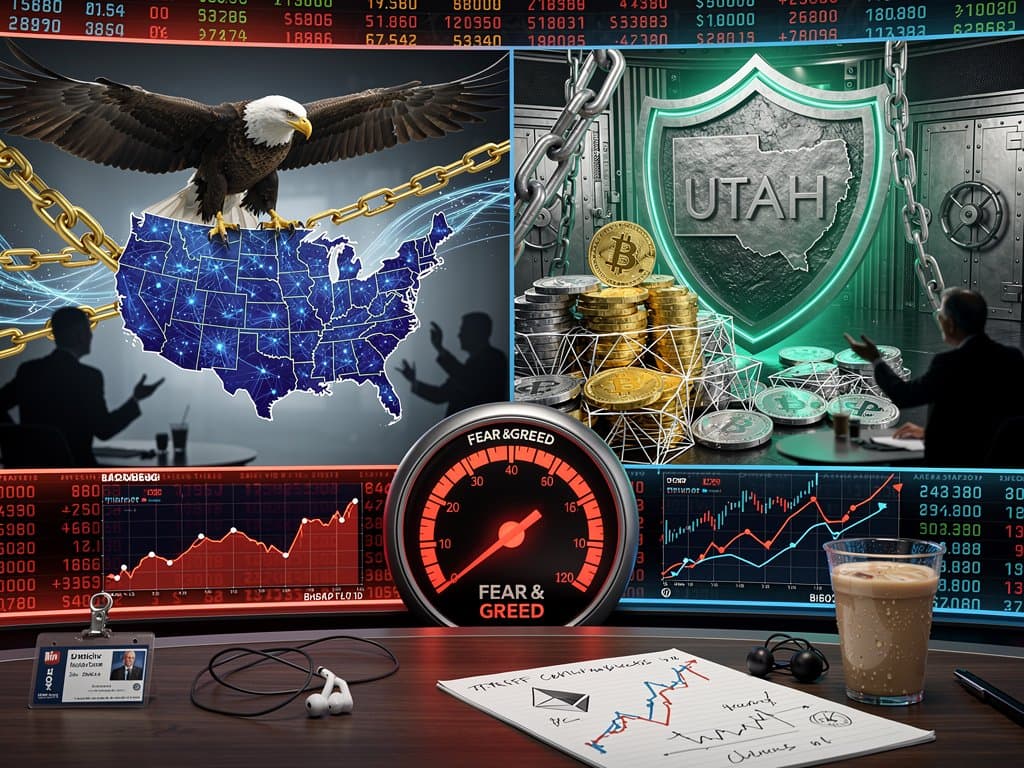
- 1. Utah Rep. Moore rejects Trump's block on state AI regulations.
- 2. Crypto Fear & Greed Index drops to 27 on policy fears.
- 3. Bitcoin at $75,954 USD holds amid GOP AI regulation rifts.
Utah Rep. Blake Moore rejects President-elect Donald Trump's call to block state AI regulations. An AP News report details his firm stance on local control. This action highlights GOP tensions over AI regulation. The Crypto Fear & Greed Index drops to 27.
Bitcoin trades at $75,954 USD. It falls 0.4% in 24 hours, per CoinGecko. Ethereum drops to $2,337.04 USD, down 1.1%. Investors fear regulatory fights will slow AI tools in crypto trading.
XRP rises 0.2% to $1.44 USD. BNB falls 1.1% to $626.66 USD. USDT stays at $1.00 USD.
- Asset: BTC · Price (USD): 75,954 · 24h Change: -0.4%
- Asset: ETH · Price (USD): 2,337.04 · 24h Change: -1.1%
- Asset: XRP · Price (USD): 1.44 · 24h Change: +0.2%
- Asset: BNB · Price (USD): 626.66 · 24h Change: -1.1%
- Asset: USDT · Price (USD): 1.00 · 24h Change: 0.0%
Trump Pushes Federal Control in AI Regulation
President-elect Trump urges federal rules to override state AI regulations. He claims national standards boost U.S. AI leadership. Patchwork state laws slow tech rollouts and raise company costs.
Google and OpenAI agree. They face high costs to meet varied state rules. Federal oversight would speed AI approvals for data privacy and safety.
Trump plans executive actions after his January 20, 2025, inauguration. This fits his deregulation goals. He earlier fought Biden's AI orders.
Fintech firms rely on AI to detect fraud. Banks scan transactions in seconds to catch scams. Uniform rules cut compliance costs.
Rep. Moore Defends State Rights on AI Regulation
Blake Moore represents Utah's 1st District. He co-chairs the House AI Caucus. His bill lets states fight deepfakes and algorithm bias.
Utah stresses consumer protections. Moore upholds GOP states' rights traditions. Trump allies favor national power.
Republicans hold Congress post-2024 elections. Party rifts delay AI laws. Clear rules aid crypto tools like Fetch.ai.
GOP Divide Slows Federal AI Regulation
Reuters reports a bill for states to regulate AI by 2026. GOP delays push states forward. California audits AI hiring bias.
Texas fights election deepfakes. Utah drafts AI ethics rules. States fill federal voids.
Fintech uses AI for loan decisions. Regulators probe opaque algorithms. AWS and Microsoft invest billions in AI GPUs.
Diverse rules cost companies time and money.
State AI Rules Hit Crypto Trading Bots
States eye AI trading bots. These bots predict crypto prices and trade automatically. Nevada reviews crypto-AI mixes.
Coinbase wants federal clarity. Trading volumes fall with Fear Index at 27. Bitcoin draws safe-haven buys near its 21 million cap.
Ethereum staking taps AI for yields. Moore's caucus seeks state flexibility.
DeFi tests AI in smart contracts for loans. Policy uncertainty slows venture capital.
Europe's MiCA rules started July 2024 for crypto. U.S. states mirror stablecoin rules.
AI Regulation Shapes Fintech Innovation
AI powers robo-advisors with trillions in assets. They customize investment advice. Rules will mold risk models.
SingularityNET builds blockchain AI markets for data sharing.
Bitcoin holds above $75,000 USD. Ethereum tests $2,300 support. GOP unity will shape AI regulation paths. Moore's bill vote tests divides. Investors crave clarity for AI-driven fintech.
Frequently Asked Questions
What is Trump's stance on state AI regulation?
Trump pushes federal preemption to block state AI laws. Uniform national rules boost innovation and cut compliance costs for tech firms.
Why does Rep. Blake Moore oppose Trump's AI policy?
Moore backs state rights for local AI rules on deepfakes and bias. His bill empowers states amid GOP federalism debates.
How does AI regulation affect crypto markets?
Fear & Greed Index at 27 shows caution. Bitcoin at $75,954 USD and Ethereum at $2,337.04 USD dip on policy uncertainty for AI tools.
What role do states play in AI regulation?
States like Utah, California, and Texas create tailored AI laws on bias and privacy. They act where federal rules lag.