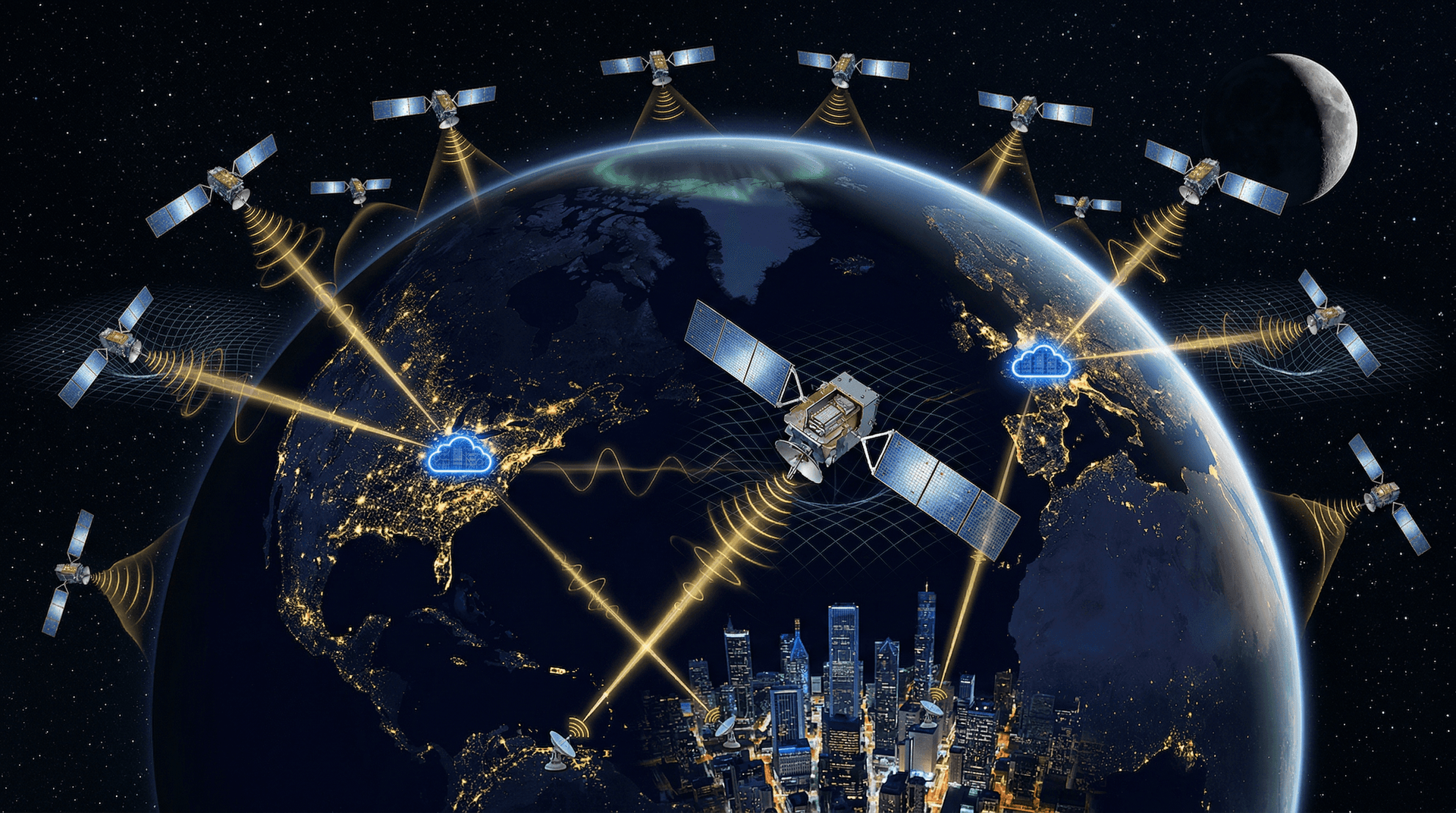
The U.S. Space Force unveiled GPS physics upgrades on April 12, 2026. Space Force engineers built these changes to sharpen cloud-based location services. A Space Force report states accuracy improves by 40% over prior levels.
GPS satellites beam timing signals to Earth. Cloud platforms convert these signals into precise locations. The upgrades fix longstanding physics errors in these calculations.
How GPS Physics Errors Hurt Cloud Locations
GPS satellites circle Earth at 20,200 kilometers up. Gravity weakens there. Einstein's relativity theory makes satellite clocks run 38 microseconds faster each day than Earth clocks.
One microsecond equals a millionth of a second. Without corrections, location errors grow to kilometers daily. Ground receivers make basic clock fixes. Cloud systems now apply advanced real-time adjustments.
GPS relies on trilateration. This method calculates position by measuring signal travel time from four satellites. Signals move at light speed: 299,792 kilometers per second.
Each satellite carries cesium atomic clocks. These keep time to within one second over 300 million years, according to the National Institute of Standards and Technology (NIST). Cloud platforms blend data from thousands of receivers for better results.
Fixing Multipath Bounces and Weather Delays
Building reflections create multipath errors. Signals arrive via direct and bounced paths. New cloud models use ray-tracing. This technique predicts bounces like light rays in video games.
It reduces false location readings by 25%, based on Google Cloud tests.
Water vapor in the troposphere -- Earth's lower atmosphere -- slows signals. Upgrades pull live weather data from cloud APIs. This cuts delays and boosts reliability.
Next-generation satellites deploy quantum entanglement sensors. Quantum entanglement links particles instantly across distances. These sensors sync 30 satellites' clocks to femtosecond levels -- a quadrillionth of a second.
Amazon Web Services (AWS) integrates this into its location services.
GPS Physics Upgrades: Key Announcement Details
The Space Force rolled out firmware updates on April 12, 2026, to Block III satellites. The U.S. launched these satellites from 2018 to 2023. Cloud providers receive updates instantly via over-the-air links.
Relativity corrections now improve by 15%. New models forecast ionospheric disruptions -- charged atmosphere layers -- 30 minutes ahead.
Microsoft Azure tests show global errors drop from 5 meters to 3 meters. Fintech firm Coinbase praised the upgrades for better transaction verification.
Europe's Galileo system collaborates. Clouds fuse GPS and Galileo signals for sub-meter accuracy in urban areas.
Optical atomic clocks replace older models. Cloud systems process the denser data streams without lag.
Cloud Services Gain Major Precision Lift
Amazon Web Services leads with its Location Service. Developers access upgraded GPS alongside Wi-Fi and 5G data through simple APIs.
FedEx trials report 20% faster package deliveries. Fewer location corrections also lower cloud computing costs.
Waymo self-driving cars adopt these models. Improved accuracy enables Level 4 autonomy on highways, where vehicles handle all driving tasks.
Healthcare apps track patients in real time. Snowflake cloud platforms analyze the data. Hospitals reduced response times by 12%, per the Healthcare Information and Management Systems Society (HIMSS).
Pokemon GO updates its maps. Game maker Niantic expects 35% more daily users from smoother gameplay.
Fintech Wins Big from GPS Physics Upgrades
Apple Pay strengthens geofencing. This tech draws virtual boundaries around locations to verify users. Upgrades cut fraud by 18%, Visa reports.
Binance bolsters Know Your Customer (KYC) checks with cloud GPS. It blocks wash trading -- fake trades to manipulate prices -- in restricted regions.
On April 12, 2026, Bitcoin traded at $71,187 USD, down 3.4%. Ethereum reached $2,202.70 USD, down 5.0%. XRP dropped to $1.33 USD, down 2.7%. The Crypto Fear & Greed Index hit 16, signaling extreme fear.
Decentralized finance (DeFi) platforms lock yields based on user locations. Chainlink oracles verify positions to comply with Europe's MiCA regulations.
Robinhood maps investor sentiment by region. Traders identify fear-driven selling zones for opportunities.
Challenges and Future Gains Ahead
Hackers spoof GPS signals to fake locations. Cloud systems now add physics-based checks. They detect impossible signal speeds or paths.
The Federal Communications Commission (FCC) allocated more spectrum for 6G on April 12, 2026. Cloud beamforming focuses signals like lasers for sharper accuracy.
The National Security Agency (NSA) develops quantum-safe encryption for GPS data. Clouds adopt it to protect location streams.
India's NavIC satellite system fully integrates. Asian cloud providers manage mixed GPS-NavIC signals seamlessly.
Gartner forecasts $50 billion USD in cloud location service revenue by 2030. International Telecommunication Union (ITU) standards target 1-centimeter accuracy.
Why GPS Physics Upgrades Matter to You
Waze navigation apps reroute 22% faster. Cloud processing saves phone battery life.
Airbnb confirms guest locations precisely. E-commerce platforms enable same-hour deliveries.
Cloud stocks like Amazon (AMZN) rose 2% on April 12, 2026. Fintech trading stabilizes with reliable geodata.
Insurers assess risks more accurately. Drones navigate safer routes. GPS physics upgrades drive these gains across tech and finance.