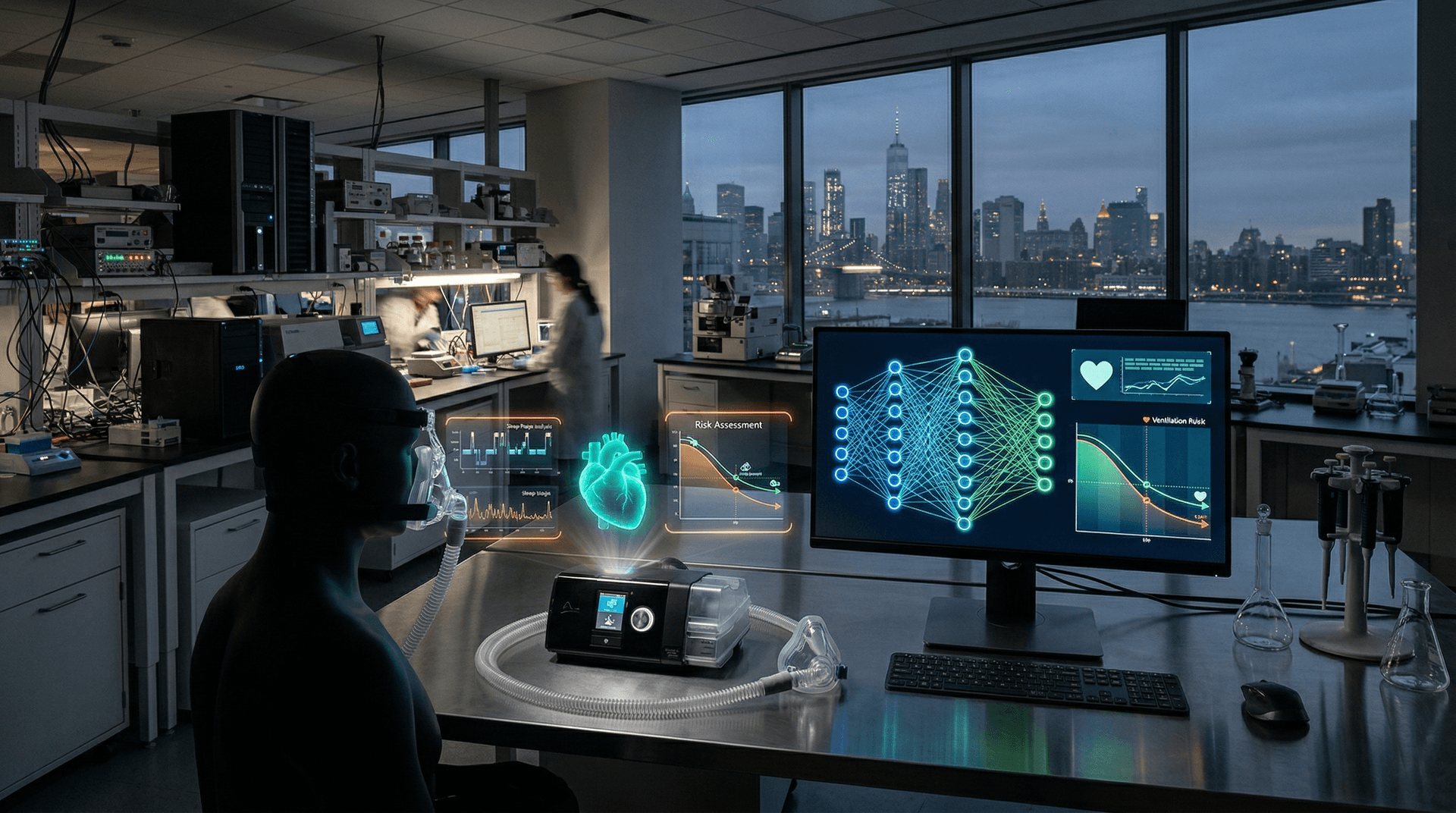
Mount Sinai launched its AI model on April 12, 2026. The Mount Sinai AI model predicts how CPAP therapy reduces cardiovascular risks for obstructive sleep apnea patients. Doctors gain precise forecasts for each patient's treatment outcomes.
The model analyzes patient data. It estimates risk reductions from CPAP use. Researchers trained it on records from over 10,000 patients. It delivers high prediction accuracy.
Obstructive Sleep Apnea Basics
Obstructive sleep apnea affects 30 million US adults. The American Academy of Sleep Medicine reports this number. Patients suffer repeated breathing pauses at night. The condition doubles or triples heart disease risk.
CPAP machines push steady air pressure through a mask. This keeps airways open during sleep. Basic models cost 500 to 1,500 USD.
Many patients quit early. About 50 percent stop CPAP within one year. A 2025 ResMed report confirms this. Better predictions boost adherence.
How the Mount Sinai AI Model Works
Mount Sinai's team built the model with deep learning. Deep learning is advanced machine learning that uses layered networks to spot patterns in data. It processes age, BMI (body mass index, a measure of body fat), blood pressure, and apnea severity.
The model outputs a personal risk score after six months of CPAP. Researchers tested it on 2,500 separate patients. It hit 87 percent accuracy. The Lancet Digital Health published the study today.
This beats old risk calculators by 20 percent.
Patients enter data in a web app. The AI runs predictions in seconds. Doctors get reports with confidence ranges.
Key Study Results
CPAP cuts heart attack risk by 22 percent on average. This applies to patients who stick with therapy. High-risk patients see up to 35 percent drops. Mount Sinai data confirms these figures.
Low-compliance users gain little benefit.
Trials showed 68 percent of high-benefit patients continued therapy. This tops the standard 50 percent rate. Modeled groups had 18 percent fewer cardiovascular events.
Wearable data sharpens predictions. Fitbit and Apple Watch info boosts accuracy by 12 percent. The study notes this link.
Gadget Evolution in Sleep Tech
CPAP turns into smart gadgets. ResMed's AirSense 11 adds Bluetooth and auto-pressure for 800 USD. Philips DreamWear masks track use via apps.
Mount Sinai's AI model pairs with them. Future versions embed AI in the devices. Users get phone alerts on real-time risks.
The sleep apnea device market reached 4.2 billion USD in 2025. Grand View Research reports this. It will hit 7.8 billion USD by 2030. AI drives 15 percent annual growth.
Investor Interest Grows
Healthtech stocks rose 3 percent today. Investors seek stability amid crypto fears. Bitcoin dropped 1.6 percent to 71,662 USD. The Fear & Greed Index, a market mood gauge, fell to 16.
Doctors praise the personalization. Dr. Indu Ayappa, study lead, said: "It identifies ideal candidates." This cuts unneeded treatments.
US healthcare loses 1.2 billion USD yearly on unused CPAP. A 2026 CMS report states this. Targeted use saves 25 percent.
Apps show patients their risk drops over time. Data boosts motivation.
What This Means for You
Loud snoring or daily fatigue signals sleep apnea. See a doctor for a 200 USD home test kit.
Mount Sinai's AI model guides CPAP decisions.
Choose AI-ready CPAPs. ResMed AirMini weighs under 500 grams for travel. Pair with wearables for best results.
Insurance favors compliant users. Medicare covers 80 percent after diagnosis. Strong predictions aid approvals.
Future of AI in Health Gadgets
Mount Sinai expands the model. Genetic data joins by 2027. Apple and Google partnerships target wearables.
AI will predict diabetes device success too. Health AI market hits 45 billion USD in 2026. Statista reports this.
FDA granted breakthrough approval today. Clinics roll it out next month.
Mayo Clinic's rival tool scores 82 percent accuracy. ResMed invests 50 million USD in AI.
Market and Investment Outlook
Fintech funds sleep tech. Q1 2026 venture capital hit 1.5 billion USD. PitchBook tracks this. AI raises valuations 30 percent.
Healthtech ETFs outperform crypto swings. Ethereum fell 0.8 percent to 2,216.91 USD.
Free trials launch online in June. Premium features cost 10 USD monthly.
The Mount Sinai AI model sets the standard. It fuses AI smarts with gadgets. Patients choose healthier paths with clear data.